Guardians of Lake Michigami
How local tribes are fighting for the Great Lakes
By Anna Faller | Aug. 8, 2026
It’s a founding belief of most indigenous cultures that caring for the earth is important because the earth cares for us.
Though this concept continues to shift through the modern fog (sometimes literally) of climate change, sudden weather events, and looming industrial threats like that of Line 5, Burt Lake Band historian Deborah Richmond stresses that it’s never been more important to prioritize our connection to the planet, especially as it concerns the Great Lakes.
“Everything is connected,” she says. “The health of the Great Lakes comes into contact with thriving nature and clean water everywhere.”
Northern Express sat down with representatives from the Burt Lake Band (BLB) and the Little River Band of Ottawa Indians (LRBOI) to talk about traditional practices, climate goals, and the steps we can take to ensure Lake Michigan and its sibling lakes remain healthy for future generations.
Treaty History
According to Tina VanDoornik, Great Lakes fisheries biologist with the Little River Band of Ottawa Indians, the foundation of the tribe’s conservation efforts goes back to the 1836 Treaty of Washington, wherein Anishinaabe nations ceded nearly 14 million acres of Michigan’s northern lower and upper peninsulas, including the LRBOI’s ancestral land, to the U.S. government.
In exchange, the agreement stipulated that those tribes would receive perpetual gathering, hunting, and fishing rights for those ceded lands and waters.
Over the past two centuries, VanDoornik notes that multiple subsequent treaties have continued to govern this shared allocation among the federal government, the state of Michigan, and the original tribes the treaty convened, now known as the Chippewa Ottawa Resource Authority (CORA). Locally, these groups include the LRBOI, as well as the Little Traverse Bay Bands of Odawa Indians and the Grand Traverse Band of Ottawa and Chippewa Indians.
“Sharing resources and being involved in collaborative projects has really helped us have a voice and a seat at the table for making management decisions,” she says.
Historically Lake Michigan/Michigami is both culturally and existentially significant for the LRBOI, which relied heavily on fishing for subsistence, a tradition that remains intact through recreational and commercial participants. VanDoornik also highlights the tribe’s spiritual connection to the Great Lakes, which incorporates fish as part of a larger clan system and associates the health of those waters with abundance and fertility.
Big Lake Problems
Overall degradation of the lake, however, is an increasingly concerning issue, she says, especially as it relates to invasive species like quagga mussels snapping up the tiny zooplankton and other invertebrates larval whitefish need to survive.
“They just don’t have any food left, so we don’t see any young recruitment coming into the population, which means that we don’t have adults in the population for our fishers to catch,” VanDoornik explains.
Not only does this compromise the LRBOI’s traditional fishing practices, which historically included whitefish as well as lake trout and even sturgeon (though dwindling populations of the latter have since been flagged for rehabilitation), but also threatens the lake’s biodiversity through outflow of nutrients and an imbalanced food hierarchy.
Per VanDoornik, other recent challenges include climbing water temperatures and UV stress, which can also inhibit access to food; hardening shorelines (read: human development); pollution; and an increasingly-volatile climate whose effects like swelling water levels, weather catastrophes, and wildlife abnormalities are nearly impossible to predict.
In response, the LRBOI has undertaken a number of preservation projects, which range from environmental work, to wetland and forestry programs and beyond.
Key projects include an Arctic Grayling Restoration Initiative on the north end of the Manistee River—this species of fish was brought back from extirpation last year—as well as a Lake Sturgeon Rehabilitation Program, which was established in 2001. Long-term monitoring assessments for water quality are another focus, which the LRBOI facilitates alongside other tribes and government agencies, including the U.S. Fish and Wildlife Service, to build long-term data for future use.
As VanDoornik notes, though, the most powerful resource for preserving our Great Lakes is recognizing that small actions have impact.
“Just being conscious about your interactions with the environment and knowing that things can change with just one person is [really important],” she adds. “One person can make a difference!”
Trickling Down
Problems that plague Lake Michigan trickle down to its tributaries, the interwoven web of rivers, bays, streams, and inlets that connect the Great Lakes. Among these is Burt Lake in Cheboygan County, which is the ancestral home of the Burt Lake Band.
Burt Lake Band historian Deborah Richmond says that Burt Lake and its surrounding waters have sustained native communities for hundreds of years. This is because the lake’s forest-cushioned inlet made it the perfect “protected harbor” to settle, made even more convenient by its access to the Inland Waterway, a 40-mile series of lakes and rivers connecting Crooked Lake to Lake Huron.
Consequently, the Burt Lake Band’s relationship to its namesake body was more about travel—which, in the 1800s, took place largely by boat—and establishing a flowing trade highway so members could sell their traditional crafts to visitors (headlined by porcupine quill boxes and black ash baskets), facilitate tours, and even connect with far-flung fur trappers. Richmond also highlights the importance of plentiful wildlife and clean water for the band’s survival.
Many of these practices, however, were lost as a result of the Burt Lake Burnout, wherein the tribe was forcibly removed from their lands and their villages burned at the turn of the 20th century. Consequently, Richmond explains, many of the band’s lake-centric initiatives surround preserving, and in many cases, reclaiming, the traditional teachings that define their culture.
“We’re relearning how to go smelt dipping, [for example],” she says, “how to build traditional birch bark smokers, and how to [maintain] wild rice in some of the smaller lakes. It matters to us in this way, because without these lakes nearby, we can’t relearn some of these things that we used to know.”
Where Culture and Environment Meet
As Richmond stresses, the success of those efforts also depends on the health of our Great Lakes and their connected waters. This is where local organizations like the Burt Lake Preservation Association (BLPA) come into play.
Though not directly affiliated with the Burt Lake Band (which Richmond notes is still quite small), the BLPA, a volunteer-led nonprofit, shares the tribe’s preservation goals, which it aims to amplify even further by convening local communities through stewardship and education.
“These lakes and rivers were here long before [European settlers] came,” BLPA president Dawn Webb says. “Having that knowledge of their history and how they were formed is crucial for continuing to keep them healthy.”
With that in mind, the group is taking steps to manage invasive species—notably, Eurasian watermilfoil (an aquatic plant that can spread to compromise sunlight) and the ever-pervasive round goby, which poses serious danger to local bass populations—as well as surveying shorelines and water quality throughout the Burt Lake watershed, whose 371,000-acre span encompasses such major rivers as the Sturgeon, Crooked, and Maple, along with several nearby lakes.
They’ve also helmed initiatives ranging from expanded e-coli water testing. “Whole subdivisions had septic systems under water for an extended period after the spring flooding. We had to be sure our members were safe,” Webb explains.
Other ongoing BLPA projects include providing resources to support the expansion of municipal sewer systems throughout the village of Indian River and facilitating local stewardship through seasonal newsletters, educational events, and even providing input for an updated Inland Waterway stewardship guide (also a Tip of the Mitt Watershed Council undertaking).
As Webb underscores, more passionate Great Lakes advocates make for a greater impact.
“I think everyone has a role to play,” she adds. “Making sure we have clean water and healthy shorelines going into the future is everyone’s [responsibility].”
For more information on the Burt Lake Band or the Little River Band of Odawa Indians, visit their respective websites: burtlakeband.org, and lrboi-nsn.gov.
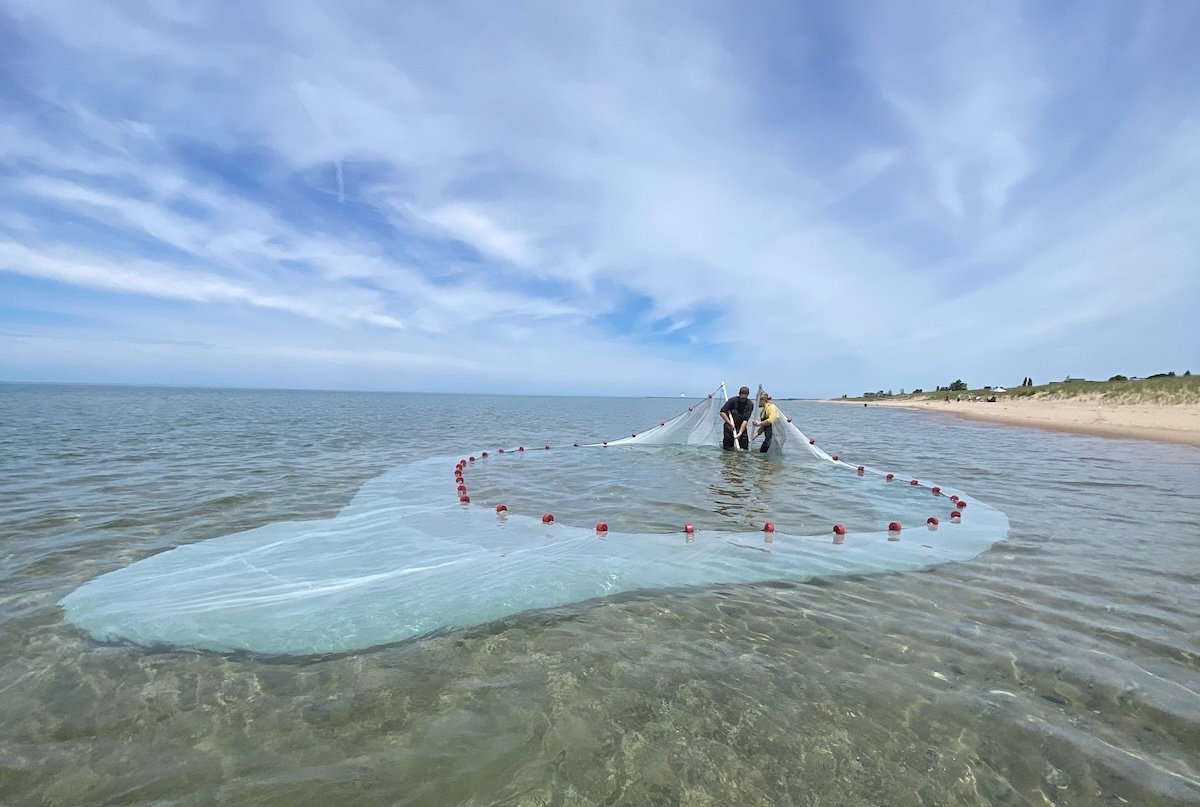
Photo: Little River Band members seine fishing along the beach.

Trending
A Big Push for Land Protection in Leelanau
Fresh on the heels of a massive lift to preserve the former Sugar Loaf ski area, the Leelanau Conservancy is trying to close… Read More >>
Parting Ways with Hazardous Waste
Have you been doing home and lawn projects all summer long? If so, you may have some products like deck stain, fertilizer, o… Read More >>
The Great American Pie Contest
Take a bite out of Antrim County Fair’s Great American Pie Contest! Although Antrim has one of Michigan’s smalle… Read More >>